Tip #1: Strategically organize your study time

Tip #1: Strategically organize your study time

Here is one of my precious little tips for the WSET 2:
Managing your revision time! 

The amount of personal work required to prepare for the WSET 2 is estimated by the WSET Global to be 11 hours.
The WSET 2 has set up a grading system according to the different learning objectives.

→ So I made a summary chart that relates this grading scale to the learning time needed so that you gain efficiency and optimize your study time ⏳💪 

Of course, it's not to the minute, but it already gives you an idea of how much of your personal work time you need to devote to each goal!
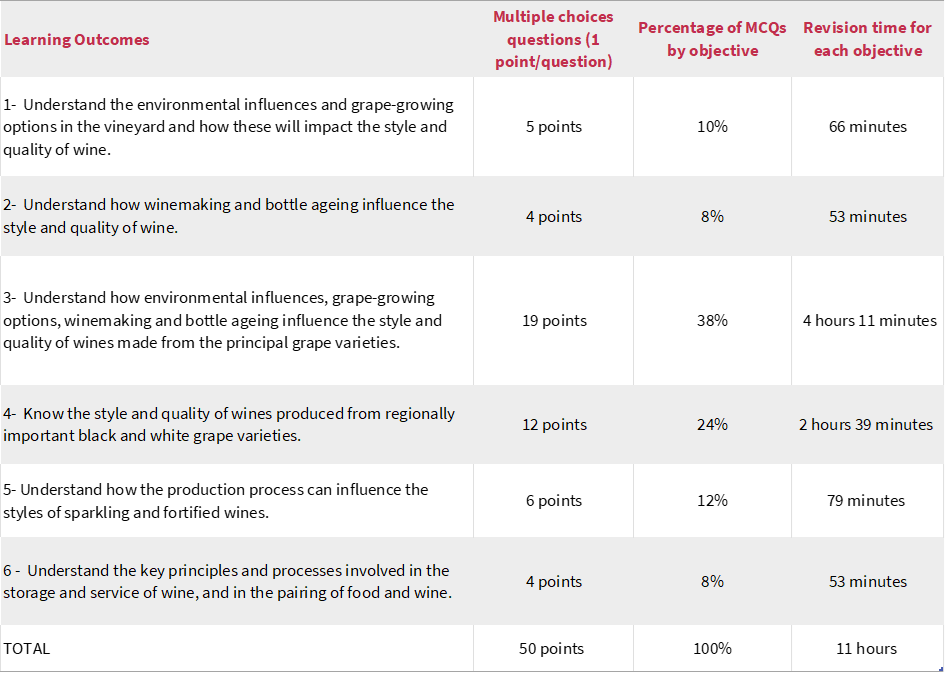


So in conclusion, you need to spend more than half of your preparation time on learning objective #3 and #4. I'll let you have a look and stay available if needed!

Wineset level 2: Study Guide

Acheter maintenantEn savoir plus

My little tips 🤫😉

  • Tip #1: Strategically organize your study time
  • Tip #2: Make revision sheets that summarize all the knowledge
  • Tip #3: Practice

Learning outcome 1: understand the environmental influences and grape-growing options in the vineyard and how these will impact the style and quality of wine

  • Vine
  • The needs of the vine
  • Composition of a grape
  • Stages of grape formation and ripening
  • Environmental factors in vines
  • Viticulture
  • Understanding the label

Learning outcome 2: understand how winemaking and bottle ageing influence the style and quality of wine

  • Alcoholic fermentation process
  • White wine-making process
  • Red and Rosé wine-making process
  • Maturation

Learning Outcome 3: Understand how environmental influences, grape-growing options, winemaking and bottle ageing influence the style and quality of wines made from the principal grape varieties.

  • CHARDONNAY
  • PINOT NOIR
  • CABERNET SAUVIGNON & MERLOT
  • SAUVIGNON BLANC
  • SYRAH/SHIRAZ
  • RIESLING
  • PINOT GRIS/PINOT GRIGIO

Learning Outcome 4 (1): Know the style and quality of wines produced from regionally important black grape varieties.

  • GAMAY
  • GRENACHE/GARNACHA
  • TEMPRANILLO
  • NEBBIOLO
  • BARBERA
  • SANGIOVESE
  • CORVINA
  • MONTEPULCIANO
  • PRIMITIVO/ZINFANDEL
  • PINOTAGE
  • CARMENERE
  • MALBEC

Learning Outcome 4 (2): Know the style and quality of wines produced from regionally important white grape varieties.

  • CHENIN BLANC
  • SEMILLON
  • VIOGNER
  • GEWURZTRAMINER
  • VERDICCHIO
  • CORTESE
  • GARGANEGA
  • FIANO
  • ALBARINO
  • FURMINT

Learning Outcome 5 (1) : Understand how the production process can influence the styles of sparkling wines.

  • The principle
  • The fermentation in the bottle
  • The traditional method
  • Transfer method
  • The fermentation in closed tanks

Learning Outcome 5 (2): Understand how the production process can influence the styles of sweet wines.

  • The principle
  • The methods

Learning Outcome 5 (3): Understand how the production process can influence the styles of fortified wines.

  • The principle
  • XÉRÈS/SHERRY
  • PORTO

Learning Outcome 6: Understand the key principles and processes involved in the storage and service of wine, and in the pairing of food and wine

  • The ideal conditions for tasting
  • The systematic approach
  • Food and wine pairing
  • Wine conservation
  • Operating temperature
  • Opening the bottle
  • Decanting
  • The most common defects
  • Preservation